
Le Wagg-Poids de la Ville d'Amsterdam
1879
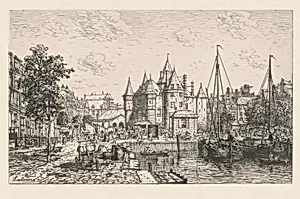
Medium
etching on chine collé
Dimensions
image: 14.8 × 24.2 cm (5 13/16 × 9 1/2 in.) plate: 20 × 28.2 cm (7 7/8 × 11 1/8 in.) sheet: 24.3 × 32.8 cm (9 9/16 × 12 15/16 in.)
Classification
Department
CG-E
Museum
National Gallery of Art, Washington, D.C.
Credit
Corcoran Collection (Bequest of Frank B. Bristow)
Accession Number
2015.143.123
Rights
Public Domain
Art Historical Context
Maxime Lalanne’s 1879 etching captures the weighbridge, or public scale, of Amsterdam, a functional civic structure that once stood as both architectural landmark and symbol of the city’s bustling trade. Created during a period when European artists turned renewed attention to urban scenes and everyday monuments, the print preserves the building’s distinctive Dutch design with careful attention to its proportions and surroundings. Lalanne executed the image as an etching on chine collé, a technique in which a delicate sheet of Chinese paper is bonded to a sturdier backing during printing. This method allowed him to achieve fine tonal gradations and crisp architectural detail while giving the impression of luminosity, qualities especially valued in nineteenth-century printmaking. The resulting impression measures just under six by ten inches, inviting close viewing that rewards the observer with subtle textures of brick, water, and sky. Now part of the National Gallery of Art’s Corcoran Collection, the print offers today’s visitors a glimpse of Amsterdam’s historic infrastructure through the refined lens of French etching traditions. Its modest scale and meticulous technique highlight how Lalanne transformed an ordinary civic site into a quietly evocative work of art.
About the Artist
Maxime Lalanne · 1827–1886
François Antoine Maxime Lalanne (1827–1886) was born in Bordeaux into a family of civil servants, initially pursuing classical studies and a law career. At the Institution Oré, he learned drawing from instructor Saulnier and showed early promise, exhibiting pencil and pastel works at Bordeaux's Philomathique Society in 1850, where he earned a bronze medal. Encouraged by architect Léo Drouyn, Lalan...