
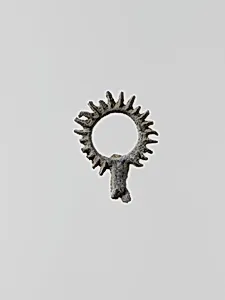
Lead wreath
Unknown Artist
6th–5th century BCE
Medium
Lead
Dimensions
Height: 1 1/8 in. (2.9 cm)
Classification
Miscellaneous-Lead
Culture & Period
Greek, Laconian · Archaic
Department
Greek and Roman Art
Museum
Metropolitan Museum of Art, New York, NY
Credit
Gift of A. J. B. Wace, 1924
Accession Number
24.195.158
Rights
Public Domain
Tags
Art Historical Context
This delicate lead wreath, crafted in ancient Laconia (the Spartan region of Greece) during the Archaic period6th–5th BCE), offers a glimpse into everyday religious and funerary practices of the time. Standing just 1 1/8 inches (2.9 cm) tall, it was likely a votive offering to deities or placed in a tomb, mimicking grander wreaths of olive, laurel, or gold awarded to victors in athletic games or sacred rituals. Lead, a soft and malleable metal, was an accessible medium for such small-scale replicas, allowing even modest worshippers to express devotion. In Laconian culture, known for its austere yet deeply pious Spartan ethos, wreaths symbolized triumph, divine favor, and the afterlife's continuity. This artifact highlights the Archaic era's transition toward more naturalistic forms, with its simple, looped design evoking living foliage despite the humble material—possibly cast or hand-formed through basic hammering techniques. Such objects were common in sanctuaries like those of Artemis Orthia, underscoring Greece's widespread use of miniatures for personal piety. Now at the Metropolitan Museum of Art, thanks to a 1924 gift from archaeologist A. J. B. Wace, this wreath invites us to imagine the hands that shaped it millennia ago, bridging the mortal world and the divine in a tangible, enduring way.