
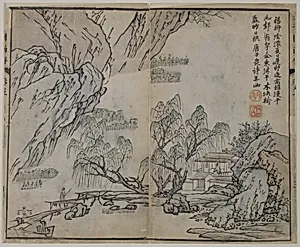
清 王槩 芥子園畫傳|Leaf from the Mustard Seed Garden Manual of Painting (Jieziyuan huazhuan)
probably 1878 edition
Medium
Woodblock print; ink and color on paper
Dimensions
9 5/8 x 11 13/16 in. (24.4 x 30 cm)
Classification
Prints
Culture & Period
China · Qing dynasty (1644–1911)
Department
Asian Art
Museum
Metropolitan Museum of Art, New York, NY
Credit
Rogers Fund, 1924
Accession Number
CP8
Rights
Public Domain
Tags
Art Historical Context
This exquisite woodblock print is a leaf from the *Mustard Seed Garden Manual of* (*Jieziyuan huazhuan*), compiled by Gai during China's Qing dynasty (16441911). Likely from the 1878 edition, it the manual's enduring legacy as one of the most painting guides in East Asian art history. First published in the late 17th century, multi-volume series—named after the publisher's garden—taught generations of artists through precise illustrations and instructions on brushwork, composition, and natural motifs. Printed in ink and color on paper, this 9⅝ × 11⅞-inch sheet (24.4 × 30 cm) showcases the Qing era's mastery of woodblock printing, a technique that allowed affordable mass reproduction of complex designs. Tagged for "Trees," it likely demonstrates stylized methods for depicting foliage, branches, and trunks, reflecting traditional Chinese ink painting principles rooted in literati traditions. These pages emphasized poetic harmony with nature, blending technical precision with artistic expression. Housed in the Metropolitan Museum of Art's Asian Art Department (Rogers Fund, 1924), this print highlights how such manuals democratized elite artistic knowledge, influencing painters across Asia for centuries and preserving classical techniques amid dynastic change. A window into Qing cultural reverence for nature and scholarship!
About the Artist
Wang Gai · 1645–1710
Wang Gai (王概, 1645–1710), a prominent Qing dynasty painter from Xiushui in Zhejiang province, established himself in the vibrant cultural hub of Nanjing, where he flourished from around 1677 to 1705. Born into a scholarly family—his father-in-law was the renowned writer Li Yu (1611–1680)—Gai trained under the master Gong Xian (1619–1689), one of the Eight Masters of Jinling, adopting his robust la...