
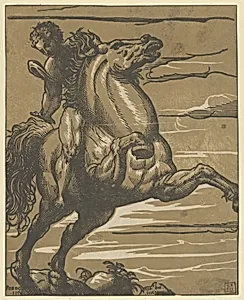
Leaping Horseman (Marcus Curtius)
Medium
Chiaroscuro woodcut from two blocks in brown
Dimensions
Mount: 12 11/16 in. × 10 7/16 in. (32.3 × 26.5 cm) Sheet: 9 1/16 × 7 5/16 in. (23 × 18.5 cm)
Classification
Prints
Department
Drawings and Prints
Museum
Metropolitan Museum of Art, New York, NY
Credit
Rogers Fund, 1922
Accession Number
22.73.3-67
Rights
Public Domain
Tags
Art Historical Context
This striking chiaroscuro woodcut captures the legendary Roman hero Marcus Curtius leaping on horseback into a fiery chasm to save the city of Rome. Created around 1560–70, the print draws on a classical tale of self-sacrifice, rendered with dramatic energy that reflects the bold compositions favored by Giovanni Antonio da Pordenone, a leading Venetian Mannerist painter. Nicolò Boldrini, the skilled printmaker, translated Pordenone’s dynamic design into this two-block woodcut printed in warm brown tones. The medium itself highlights an important Renaissance innovation. Chiaroscuro woodcuts use layered blocks to suggest light and shadow, giving the scene a sculptural depth rarely achieved in single-block prints. This technique allowed the image to convey both the horse’s powerful motion and the hero’s resolute expression, making the story vivid for viewers far from Rome. Such prints played a vital cultural role in the sixteenth century, spreading heroic narratives and artistic styles across Europe. Today, the work invites us to admire both the timeless theme of courage and the technical artistry that brought it to life.