
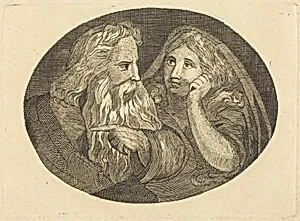
Lear and Cordelia
probably c. 1806/1808
Medium
engraving
Classification
Department
CG-E
Museum
National Gallery of Art, Washington, D.C.
Credit
Rosenwald Collection
Accession Number
1943.3.8978
Rights
Public Domain
Art Historical Context
In the National Gallery of Art's Rosenwald Collection, *Lear and Cordelia* is poignant engraving by Thomas Butts, Jr created around 1806–1808 after a design by the visionary artist William Blake. This print a dramatic moment from Shakespeare's tragedy *King Lear*, likely depicting the tender reconciliation or tragic demise of the humbled king and his loyal daughter Cordelia, evoking profound themes of forgiveness, regret, and mortality. Blake, a cornerstone of British Romanticism, was renowned for his mystical illustrations of literary classics, blending intricate line work with symbolic depth. Thomas Butts, Jr.—son of Blake's longtime patron—skillfully translated Blake's original watercolor or drawing into engraving, a meticulous intaglio technique where acid-etched lines on a copper plate hold ink for rich, tonal prints. This method allowed Blake's ethereal visions to reach wider audiences beyond elite collectors, preserving his innovative fusion of poetry and image. As a rare survival from Blake's Shakespeare series, this work highlights early 19th-century fascination with dramatic narrative art, bridging theater and visual culture. Visitors will appreciate its emotional intensity, a testament to Blake's enduring influence on how we envision Shakespeare's immortal stories.