
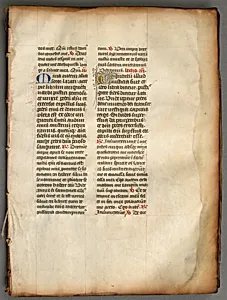
Leaves from a Missal
Unknown Artist
15th century (?)
Medium
Ink and gold on parchment
Dimensions
Overall: 7 3/16 x 5 1/8 in. (18.2 x 13 cm)
Classification
Manuscripts and Illuminations
Culture
Franco-Netherlandish
Department
Medieval Art
Museum
Metropolitan Museum of Art, New York, NY
Credit
Gift of Alice M. Dike, in memory of her father, Henry A. Dike, 1928
Accession Number
28.225.83.1a, b–.8a, b
Rights
Public Domain
Art Historical Context
These delicate leaves from a 15th-century Missal, crafted by an unknown Franco-Netherlandish artist, offer a glimpse into the opulent world of medieval liturgy. A Missal was a sacred book containing prayers, readings, and chants for the Roman Catholic Mass, and these pages—measuring just 7 3/16 x 5 1/8 inches—likely served in a church or private chapel. Produced in the late Middle Ages, they hail from a region where French and Netherlandish traditions blended, renowned for their refined illuminations that bridged Gothic elegance and emerging Renaissance naturalism. Rendered in ink and gold on vellum parchment (animal skin prepared for writing), the leaves showcase masterful techniques: intricate line work for text and borders, with burnished gold leaf creating a heavenly glow that mimicked divine light. Scribes and illuminators labored meticulously by hand, often in monastic workshops, making each page a testament to piety and artistry. The gold's radiant quality not only enhanced readability in dim churches but symbolized spiritual illumination. Housed in the Metropolitan Museum of Art's Medieval Art department (gift of Alice M. Dike, 1928), these fragments highlight the anonymous genius of medieval manuscript production—a cultural pinnacle where faith and craftsmanship intertwined, preserving Franco-Netherlandish heritage for modern eyes.