
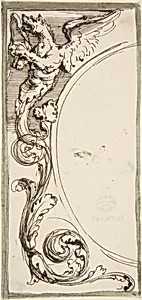
Left Half of a Cartouche with Griffin and Acanthus Scroll
1732–1802
Medium
Pen and brown ink, brush and dark green wash
Dimensions
7 11/16 x 3 5/8 in. (19.6 x 9.2 cm)
Classification
Drawings|Ornament & Architecture
Department
Drawings and Prints
Museum
Metropolitan Museum of Art, New York, NY
Credit
The Elisha Whittelsey Collection, The Elisha Whittelsey Fund, 1952
Accession Number
52.570.207
Rights
Public Domain
Tags
Art Historical Context
This delicate drawing by Carlo Bianconi captures the left half of an ornamental cartouche, a decorative frame often used in architecture and print design. Rendered in pen and brown ink with dark green wash, the work highlights a majestic griffin—part lion, part eagle—entwined with flowing acanthus scrolls. Measuring just under eight inches tall, the piece exemplifies the refined draftsmanship of eighteenth-century ornamental studies, where artists explored motifs drawn from classical antiquity to adorn buildings, furniture, and printed materials. Bianconi, active during a period of renewed interest in Greco-Roman forms, used the wash technique to suggest depth and shadow, bringing sculptural vitality to what was likely a preparatory design. Such drawings played a vital role in the transmission of decorative ideas across Europe, bridging the worlds of fine art and applied design. The griffin, a symbol of strength and vigilance, combined with the acanthus leaf—a staple of ancient Corinthian capitals—reflects the era’s fascination with mythological and natural motifs reimagined for contemporary tastes. Acquired by the Metropolitan Museum through the Elisha Whittelsey Fund, this intimate study offers visitors a glimpse into the creative process behind grand architectural embellishments. Its classification among ornament and architecture drawings underscores the enduring influence of classical vocabulary on later European design traditions.
About the Artist
Carlo Bianconi · 1732–1802
Italian scholar and archivist; first secretary of the Reale accademia di Brera. Comment on works: painter; sculptor