
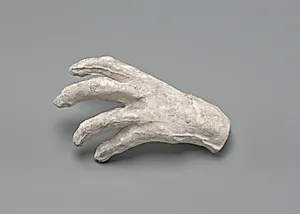
Left Hand
possibly 1880
Medium
plaster
Dimensions
overall (greatest extension): 4.2 cm (1 5/8 in.)
Classification
Sculpture
Department
CSD
Museum
National Gallery of Art, Washington, D.C.
Credit
Gift of Mrs. John W. Simpson
Accession Number
1942.5.29
Rights
Public Domain
Art Historical Context
**Left Hand** by Augustein, possibly dating to 1880, is a delicate plaster sculpture measuring just 4.2 cm in its greatest extension. This intimate study captures the nuanced anatomy of a human hand, showcasing Rodin's extraordinary ability to imbue even isolated body parts with lifelike vitality and emotional depth. Crafted in plaster—a favored medium for his preliminary models before casting in bronze—it invites visitors to appreciate the tactile quality of the material, which the sculptor's direct touch. Rodin, a pioneer of modern sculpture, revolutionized the field in the late 19th century by breaking from classical ideals. Associated with Impressionism's emphasis on light, movement, and realism, he often fragmented the human form to highlight gesture and expression, as seen in masterpieces like *The Gates of Hell*. Hands held special significance in his oeuvre, symbolizing human endeavor and fragility. This small-scale work exemplifies his meticulous study of musculature and surface texture, achieved through bold modeling techniques that mimic the play of light on skin. Now part of the National Gallery of Art's collection, thanks to the generous gift of Mrs. John W. Simpson, *Left Hand* offers a window into Rodin's creative process. Though diminutive, it packs profound artistic power, reminding us that genius thrives in the details. Pause here to ponder: what stories might this solitary hand tell?
About the Artist
Auguste Rodin · 1840–1917
François Auguste René Rodin (1840-1917) stands as the founder of modern sculpture, transforming the art form from academic tradition into expressive modernism. Born into a working-class Parisian family, Rodin faced early rejection, failing three times to gain admission to the prestigious École des Beaux-Arts. This setback forced him to work as a craftsman for nearly two decades, though his 1875 tr...