
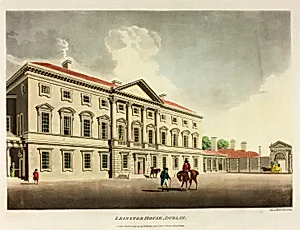
Leinster House, Dublin
published July 1792
Medium
Hand-colored aquatint in black on ivory wove paper
Dimensions
Plate: 31.7 × 42.8 cm (12 1/2 × 16 7/8 in.); Sheet: 42 × 53.8 cm (16 9/16 × 21 3/16 in.)
Classification
aquatint
Department
Prints and Drawings
Museum
Art Institute of Chicago
Accession Number
127947
Rights
Public Domain
Art Historical Context
**Leinster House, Dublin** is a captivating hand-colored aquint by James Malton, in July 1792 This exquisite print captures the neoclassical grandeur Leinster House, one of Dublin most iconic buildings, designed in the mid-18th century as the residence of the Duke of Leinster Malton, an English artist and architect renowned for his detailed topographic views included this work in his influential series *A Picturesque Descriptive View of the City Dublin* (1791–1797), offering visitors a window into Georgian Ireland's architectural splendor. The artwork's medium—aquaint on ivory wove paper, meticulously hand-colored—brings a luminous, painterly quality to the scene. Aquatint, a printmaking technique invented in the 1760s, allowed for subtle tonal gradations resembling watercolor washes, making it ideal for architectural vistas. Measuring 31.7 × 42.8 cm on the plate, the print's vibrant hues highlight the building's symmetrical facade, columns, and elegant proportions, evoking the era's Enlightenment fascination with classical harmony. Today, housed in the Art Institute of Chicago's Prints and Drawings department, this piece holds cultural significance as a historical document. Leinster House later became the seat of the Irish Oireachtas (parliament), symbolizing Ireland's political evolution. Malton's precise yet picturesque style not only preserves a pivotal landmark but invites us to appreciate Dublin's refined 18th-century urban elegance.