
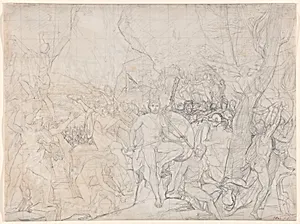
Leonidas at Thermopylae
Jacques Louis David, ca. 1812–13
About this artwork
Jacques-Louis David, the preeminent French Neoclassical artist, captured the epic heroism of *Leonidas at Thermopae* in this striking black chalk drawing from around 1812–13. The work depicts the legendary Spartan king Leon and his 300 warriors defying overwhelming Persian forces at the narrow pass of Thermopylae in 480 BCE—a pivotal moment in the Greco-Persian Wars that symbolized unyielding bravery and sacrifice. David's squared grid indicates it was a preparatory study, for his monumental 1814 oil painting on the same theme, allowing precise enlargement while emphasizing muscular male nudes, crowded soldiers, and tense drama. Neoclassicism, David's signature style, drew from ancient Greek and Roman ideals of virtue, anatomy, and moral fortitude, revived during the Napoleonic era to inspire patriotism amid political upheaval. This drawing showcases his masterful use of black chalk for bold contours and shadowy depth, evoking the grandeur of classical sculpture amid battle's chaos. Housed in the Metropolitan Museum of Art's Drawings and Prints department (Rogers Fund, 1963), it invites visitors to ponder timeless themes of courage. At 16 x 21⅝ inches, its intimate scale belies the vast heroism it conveys, bridging antiquity and David's revolutionary France.