
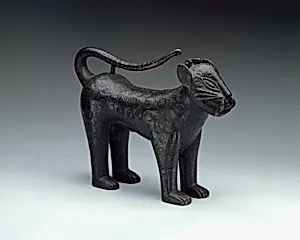
Leopard Aquamanile
16th–19th century
Medium
Brass
Dimensions
H. 6 3/4 x W. 2 5/8 x D. 8 5/8 in. (17.2 x 6.7 x 21.9 cm)
Classification
Metal-Containers
Culture
Edo
Department
Arts of Africa, Oceania, and the Americas
Museum
Metropolitan Museum of Art, New York, NY
Credit
Gift of Mr. and Mrs. Klaus G. Perls, 1991
Accession Number
1991.17.53
Rights
Public Domain
Tags
Art Historical Context
This striking Leopard Aquamanile, crafted by an Edo artist between the 16th and 19th centuries, exemplifies the sophisticated metalworking traditions of the historic Kingdom of Benin in present-day Nigeria. Fashioned from brass using the lost-wax casting technique, the vessel takes the form of a sleek leopard poised in mid-stride, its body serving as a functional container for water. Such aquamaniles were used for ritual hand-washing or ceremonial pouring, blending utility with sculptural elegance in a compact form measuring just under seven inches high. In Edo culture, leopards held profound royal symbolism, representing power, speed, and the king's authority. The animal's spotted coat and alert posture likely evoked the Oba's (king's) dominion over the natural and spiritual worlds. Created during a period when Benin’s brass guilds produced renowned courtly objects, this piece highlights the culture’s mastery of metallurgy and its integration of animal motifs into everyday and sacred objects. Acquired by the Metropolitan Museum of Art through a generous gift in 1991, the aquamanile offers visitors a tangible connection to West Africa’s artistic heritage. Its detailed casting and balanced proportions reveal the artist’s keen observation of nature, transforming a practical vessel into a potent emblem of status and identity.