
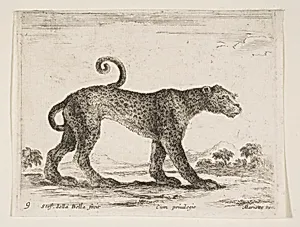
Leopard, plate 9 from "Various Animals" (Diversi Animali)
Medium
Etching; second state of three (De Vesme)
Dimensions
Sheet (trimmed): 3 3/8 × 4 7/16 in. (8.6 × 11.3 cm)
Classification
Prints
Department
Drawings and Prints
Museum
Metropolitan Museum of Art, New York, NY
Credit
Purchase, Joseph Pulitzer Bequest, 1917
Accession Number
17.50.17-258
Rights
Public Domain
Tags
Art Historical Context
Stefano della Bella's *Leopard*, plate 9 from the series *Various Animals* (*Diversi Animali*), captures the fierce elegance of its subject in a compact etching from around 1641. Created during the Italian artist's time in Paris, this print showcases della Bella's expertise as a Baroque master etcher, renowned for his intricate depictions of animals, landscapes, daily life. Pierre Mariette, a prominent French publisher, likely played a key role in its distribution, helping these works reach collectors across Europe. Etching, the medium here, allowed della Bella to achieve remarkable detail through acid-bitten lines on a copper plate, rendering the leopard's spotted coat, muscular form, and alert gaze with lifelike precision. This is the second state of three, as catalogued by De Vesme, meaning it includes refinements like added shading before the final version. At just 3 3/8 × 4 7/16 inches, its trimmed sheet size belies the technical virtuosity, making it a gem for print enthusiasts. Part of a broader fascination with natural history in the 17th century, this leopard—exotic to European eyes—highlights humanity's growing curiosity about the wild. Acquired by The Metropolitan Museum of Art in 1917 through the Joseph Pulitzer Bequest, it invites visitors to marvel at how a small print preserves the untamed spirit of nature.
About the Artist
Stefano della Bella|Pierre Mariette · 1610–1664
Stefano della Bella (1610-1664) was one of the most prolific and versatile printmakers of the Italian Baroque period, leaving behind 1,052 prints and several thousand drawings that captured the vivid essence of 17th-century European life. Born in Florence on May 18, 1610, to a family of artists, he trained initially as a goldsmith before studying painting under Cesare Dandini and etching under Rem...