
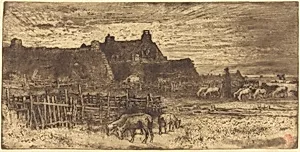
Les Bergeries, Soleil Couchant (Pastoral Scene, Setting Sun)
1826 to 1850
Medium
etching
Classification
Department
CG-E
Museum
National Gallery of Art, Washington, D.C.
Credit
Rosenwald Collection
Accession Number
1943.3.1253
Rights
Public Domain
Art Historical Context
**Les Bergeries, Soleilant (Pastoral Scene Setting Sun)** Nestled in the National Gallery of Art's Rosen Collection, Félix-Hil Buhot's etching * Bergeries, Soleil Couchant* (ca. 1826–1850) invites visitors into a tranquil 19th-century countryside. The title evokes rustic sheepfolds (*bergeries*) glowing under a fading sun, capturing the quiet poetry of rural life. Buhot, a pioneering French printmaker (184–1898), excelled etchings that blended meticulous detail with atmospheric depth, reflecting the Romantic era's fascination with nature's fleeting beauty. Etching's intaglio technique—where acid bites designs into a metal plate—allowed Buhot to achieve rich textures and subtle tonal shifts, mimicking painting's luminosity on paper. This print exemplifies his innovative approach, often involving multiple states and experimental tools for velvety effects, bridging traditional printmaking with emerging Impressionist sensibilities. Displayed in the CG-E Prints department, this work from the esteemed Rosenwald Collection underscores Buhot's legacy in graphic arts, offering a window into mid-19th-century pastoral idylls and the artistry of light at day's end. A serene gem for print enthusiasts! *(198 words)*
About the Artist
Félix-Hilaire Buhot · 1847–1898
Félix-Hilaire Buhot was born on July 9, 1847, in Valognes, a small town in Normandy, France, into a modest family—his father a wine merchant and his mother a seller of women's clothes. Orphaned by age seven after losing both parents and his maternal grandmother, he was raised by relatives, including a godfather, and received an early introduction to drawing from his adopted mother's nephew. In 186...