
Les Demoiselles de la Marne
Medium
drypoint
Classification
Department
CG-W
Museum
National Gallery of Art, Washington, D.C.
Credit
Frank Crowninshield Collection
Accession Number
1948.3.43
Rights
Public Domain
Art Historical Context
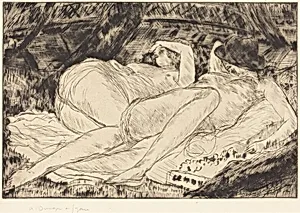
**Les Demoiselles de lane**, a captivating drypoint etching by French artist André Dunoyer deonzac from 1921, graces the National Gallery of Art part of the Frank Crownshield Collection. Created just three years after World War I end, the title evokes the Marne River region—site of pivotal 1914 and 1918 battles—depicting graceful young women in a moment of poised elegance. Segonzac, a veteran of the trenches and a key figure in the É de Paris, infused his realist style with a lively, unpretentious vitality drawn from everyday life. Drypoint, Segonzac's favored printmaking technique here, involves scratching directly into a copper plate, raising a soft burr that yields rich, velvety lines full of texture and spontaneity. This intimate medium allowed the artist to capture fluid forms and subtle tones with remarkable immediacy, distinguishing his works from smoother etching processes. The result is a print that feels hand-drawn, bridging fine art and illustration. This piece reflects the interwar era's spirit of renewal amid lingering war shadows, showcasing Segonzac's mastery in portraying the female form with warmth and modernity. A testament to early 20th-century French draughtsmanship, it invites visitors to appreciate the resilience and beauty emerging from history's tumult. (198 words)
About the Artist
André Dunoyer de Segonzac
André Dunoyer de Segonzac (1884–1974) was a leading French painter, draughtsman, engraver, and illustrator, born on 6 July in Boussy-Saint-Antoine near Paris, where he spent much of his childhood alongside time in the city. Defying his parents' initial hopes for a military career at Saint-Cyr, he pursued art, enrolling in 1900 at the École des Beaux-Arts in Paris as a general student. He studied u...