
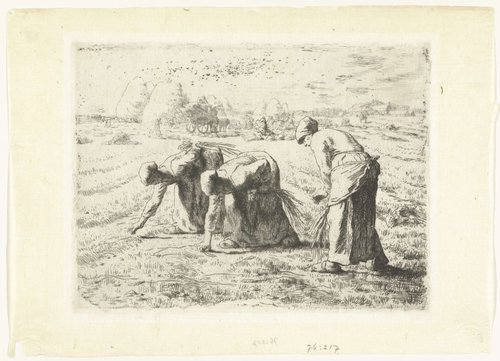
Les glaneuses
Medium
etching
Dimensions
192; 253
Rights
Public Domain
About this artwork
ets op dun papier
Art Historical Context
Jean-François Millet's *Les Glaneuses* (The Gleaners), created in 1855, is a poignant etching capturing the humble labor of rural women gathering leftover grain from the fields. As a leading figure in the Barbizon School and Realism movement, Millet shifted focus from idealized Romantic scenes to the dignified reality of peasant life in 19th-century France. work reflects the social upheavals of the era, including industrialization and rural poverty, portraying gleaning—a biblical practice symbolizing humility and sustenance—as a timeless act of resilience. Rendered as an etching on paper (measuring 192mm high by 253mm wide), the piece showcases Millet's mastery of intaglio printmaking. Using acid to bite intricate lines into a metal plate, he achieved rich tonal contrasts and fine details, allowing the subtle curves of bent backs and flowing fabrics to evoke empathy and quiet grandeur. Etchings like this made his art more accessible, bridging fine art with the masses. Culturally, *Les Glaneuses* echoes Millet's iconic 1857 painting of the same subject, now in the Musée d'Orsay, influencing later depictions of labor in art and literature. It invites visitors to ponder the beauty in everyday toil, a cornerstone of Realist innovation.