
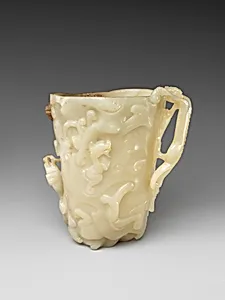
明 玉雕蟠螭杯|Libation cup with chi dragons
Unknown Artist
16th–17th century
Medium
Jade (nephrite)
Dimensions
H. 5 1/4 in. (13.3 cm)
Classification
Jade
Culture & Period
China · Ming dynasty (1368–1644)
Department
Asian Art
Museum
Metropolitan Museum of Art, New York, NY
Credit
Gift of Florence and Herbert Irving, 2015
Accession Number
2015.500.5.31
Rights
Public Domain
Tags
Art Historical Context
This exquisite libation cup, carved from nephrite jade during China's Ming dynasty (1368–1644), dates to the 16th–17th century and exemplifies the era's masterful jade craftsmanship. Standing just 5¼ inches tall, its pale green stone is intricately sculpted into a ritual vessel adorned with coiling chi dragons—wingless, playful mythical creatures known as chilong. These dynamic forms wrap around the cup's exterior, their scales and fierce expressions rendered with remarkable precision, showcasing the jade carver's skill in hollowing and detailing a hard, unyielding material. In Ming China, jade symbolized purity, immortality, and imperial virtue, often reserved for scholarly or ceremonial objects like this libation cup, used for pouring sacrificial wine in rituals. Nephrite, sourced from distant mountains, was prized for its toughness and luster, allowing artisans to create fluid, organic designs that evoked nature's vitality. The chi dragons, fierce yet auspicious protectors, embodied imperial power and good fortune, reflecting Confucian ideals of harmony. Today, this gift to the Metropolitan Museum of Art invites us to appreciate Ming jade's timeless elegance—a bridge to an age when artistry and spirituality intertwined in every curve.