
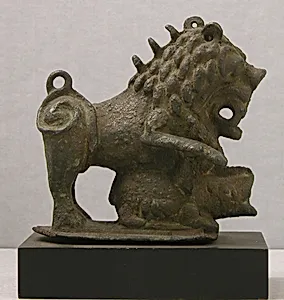
Lid of a Censer
Unknown Artist
7th century
Medium
Bronze; cast
Dimensions
Object: H. 4 in. (10.2 cm) W. 3 3/4 in. (9.5 cm) Object with mount: H. 4 15/16 in. (12.5 cm) W. 4 1/4 in. (10.8 cm) D. 2 1/2 in. (6.4 cm) Wt. 22.6 oz. (640.771 g)
Classification
Metal
Department
Islamic Art
Museum
Metropolitan Museum of Art, New York, NY
Credit
Gift of Joseph W. Drexel, 1889
Accession Number
89.2.551
Rights
Public Domain
Tags
Art Historical Context
This exquisite bronze lid from a censer, crafted in the 7th, hails from the early Islamic world, a time of rapid cultural and artistic flourishing following the rise of Islam. Censers like this were essential for burning fragrant incense during religious rituals, court ceremonies, or domestic settings, filling spaces with aromatic smoke symbolizing purity and divine presence. Its placement in the Metropolitan Museum of Art's Islamic department underscores its role in one of the world's richest traditions of metalwork. Cast in bronze—a testament to skilled artisans who mastered lost-wax techniques for intricate detailing—the lid measures about 4 inches high and wide, making it a portable yet finely wrought object. Lions, boldly depicted in the design (as suggested by its tags), were potent motifs in early Islamic art, evoking strength and pre-Islamic Sassanian influences while adapting to new aesthetic ideals. These dynamic animals, often shown in combat or repose, highlight the era's blend of functionality and symbolism. Gifted to the Met in 1889 by Joseph W. Drexel, this lid invites us to ponder the sensory worlds of medieval Muslims, where art enhanced spirituality and status. Though the artist remains unknown, its preservation reveals the enduring craft of ancient bronze founders.