
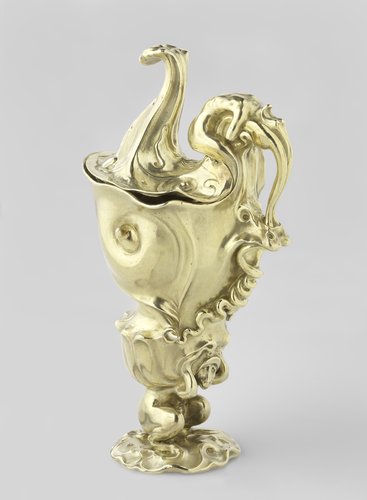
Lidded ewer
Medium
gild
Dimensions
9; 25; 14; 910
Rights
Public Domain
About this artwork
town mark
Art Historical Context
### Lidded Ewer by Adam van VianenI) Crafted in 1614 by renowned Dutch silversmith Adam van Vianen (I) (ca. 1568–1627), this lidded ewer exemplifies the opulence of the Dutch Golden Age. Standing approximately 25 cm tall with a weight of 910 grams, served as a luxurious vessel for pouring water or wine, blending functionality with artistic splendor. The medium, gilded silver (indicated by "gild"), a thin layer of gold enhancing its shine and prestige, a technique favored by elite patrons for both beauty and corrosion resistance. Van Vianen, a pioneer of the auricular style—characterized by fluid, organic forms resembling cartilage or sea creatures—elevated silversmithing to fine art. Working primarily in Utrecht and Amsterdam, his designs influenced European metalwork for generations. The presence of a town mark, a hallmark denoting the assay office of origin (likely Amsterdam), underscores its authenticity and the rigorous guild standards of the era, ensuring quality for collectors and nobility. This compact yet substantial piece (14 cm wide, 9 cm deep) reflects 17th-century Netherlands' prosperity through trade, where such ewers graced wealthy dining tables. A testament to technical mastery and innovative design, it invites visitors to appreciate the tactile elegance of Renaissance-era craftsmanship.