
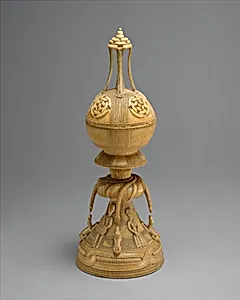
Lidded Saltcellar
15th–16th century
Medium
Ivory
Dimensions
H. 11 3/4 x Diam. 4 1/4 in. (29.8 x 10.8 cm)
Classification
Ivory|Ivory/Bone-Vessels
Culture
Sapi-Portuguese
Department
Arts of Africa, Oceania, and the Americas
Museum
Metropolitan Museum of Art, New York, NY
Credit
Gift of Paul and Ruth W. Tishman, 1991
Accession Number
1991.435a, b
Rights
Public Domain
Tags
Art Historical Context
Step into the vibrant world of early global trade with this exquisite *Lidded Saltcellar crafted by a Sapiuguese artist in the 15th–16th. Fashioned from elephant ivory—a medium symbolizing luxury and technical mastery—this vessel measures 11 3/4 inches high and 4 1/4 inches in diameter. Housed in the Metropolitan Museum of Art's Department of Arts of Africa, Oceania, the Americas, it exemplifies Sapi-Portuguese culture, a remarkable fusion born along Sierra Leone's coast. During the Age of Exploration, Portuguese traders commissioned Sapi artisans to create these ornate saltcellars for European dining tables. The Sapi, skilled ivory carvers from West Africa, blended their naturalistic style—featuring lively figures of men and women, playful dogs, and sinuous snakes—with European motifs like fantastical creatures and lidded designs. This cultural exchange highlights early globalization, where African ingenuity met Portuguese demand, producing objects that bridged continents. Today, this gift from Paul and Ruth W. Tishman (1991) captivates as a testament to hybrid artistry. Its intricate carvings invite us to ponder the lives depicted: humans in dynamic poses alongside symbolic animals, evoking stories of power, protection, and the natural world. A true treasure of cross-cultural dialogue!