
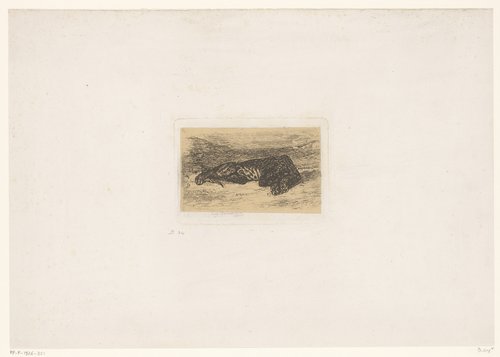
Liggende tijger in de woestijn
ca. 1830 - ca. 1833
Medium
etching
Dimensions
93; 135
Rights
Public Domain
About this artwork
verzamelaarsmerk, verso, gestempeld: Lugt 2166
Art Historical Context
Behold Eugène Delacroix's *Liggende tijger de woestijn* (Reclining Tiger in Desert), a captivating etching from around 1830–1833. As a master of French Romanticism, Delacroix infused his works with dramatic emotion, exotic allure, and a fascination for the wild. This small gem, measuring just 93 mm high by 135 mm wide, captures a majestic tiger lounging amid desert sands, evoking theamed spirit of nature that enthralled 19th-century artists. shortly after Delacroix's transformative 1832 journey to North Africa, it reflects his lifelong passion for Orientalist themes, blending observation with imaginative power. Etching, Delacroix's chosen medium here, allowed for intricate lines and rich tonal contrasts etched into a metal plate with acid. This intaglio technique produced prints of remarkable detail and immediacy, ideal for studies like this one—perhaps a preparatory sketch for larger paintings. The tiger's fluid form and shadowy contours showcase Delacroix's virtuoso draftsmanship, hallmarks of his expressive style that influenced generations, from Impressionists to modern artists. On the verso, a collector's mark (Lugt 2166) stamps its prestigious provenance, linking this piece to esteemed European collections. Gaze upon it and feel the desert's heat and the predator's quiet menace—a window into Romanticism's embrace of the sublime.
About the Artist
Eugène Delacroix · 1798–1863
Eugène Delacroix (1798–1863) stands as the defining figure of French Romanticism and a pivotal bridge to modernism. Born in Charenton-Saint-Maurice near Paris, he came from distinguished lineage—his mother descended from the prestigious Oeben-Riesener furniture dynasty, while persistent speculation suggested the statesman Talleyrand may have been his biological father, a theory supported by physic...