
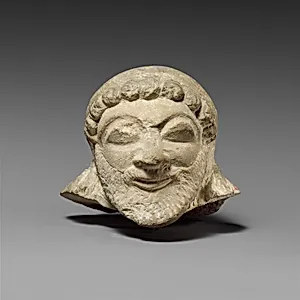
Limestone head of a silen (?)
Unknown Artist
late 6th or early 5th century BCE
Medium
Limestone
Dimensions
Overall: 3 1/2 x 3 1/4 x 2 1/4 in. (8.9 x 8.3 x 5.7 cm)
Classification
Stone Sculpture
Culture & Period
Cypriot · Archaic
Department
Greek and Roman Art
Museum
Metropolitan Museum of Art, New York, NY
Credit
Anonymous Gift, 1941
Accession Number
41.163
Rights
Public Domain
Tags
Art Historical Context
This delicate limestone head, possibly depicting a silen—a mythical companion of Dionysus known for his wild, bearded revelry—hails from ancient Cyprus during the Archaic periodlate 6th or 5th century BCE Carved in the round, its modest size (just 3½ x 3¼ x 2¼ inches) suggests it may have served as a vot offering or decorative element in a sanctuary or tomb. Cypriot art of this era blended Greek, Near Eastern, and local influences, producing robust stone sculptures that captured the human form with stylized features: prominent eyes, a broad nose, and textured beard hinting at the silen's rustic character. The use of limestone, abundant on Cyprus, allowed for intricate detailing achievable through chiseling and abrasion techniques typical of Archaic workshops. This piece exemplifies the island's role as a cultural crossroads, where Greek mythological motifs like the silen were adapted into distinctly Cypriot styles—less refined than mainland Attic works but full of earthy vigor. Its uncertain identification adds intrigue, inviting us to ponder how such figures embodied fertility, ecstasy, and the divine in everyday rituals. On view in the Metropolitan Museum of Art's Greek and Roman Art department (anonymous gift, 1941), this head offers a tangible glimpse into Archaic Cyprus, bridging mythology and craftsmanship for modern visitors.