
Limestone inscribed block
Unknown Artist
ca. 5th century BCE
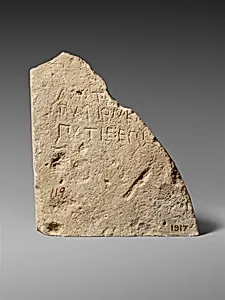
Medium
Limestone
Dimensions
H.: 6 7/8 x 6 1/4 x 2 1/8 in. (17.5 x 15.9 x 5.4 cm)
Classification
Cesnola Inscriptions
Culture & Period
Cypriot · Classical
Department
Greek and Roman Art
Museum
Metropolitan Museum of Art, New York, NY
Credit
The Cesnola Collection, Purchased by subscription, 1874–76
Accession Number
74.51.2445
Rights
Public Domain
Art Historical Context
This modest limestone inscribed block, dating to around the 5th century, hails from ancient Cyprus during the Classical period—a time when the island bridged Greek, Eastern Mediterranean, and Persian influences. Carved from durable local stone, its compact size (about 7 x 6 x 2 inches) suggests it may have served as a dedication, marker, or votive offering in a sanctuary or public space. Cypriot inscriptions like this one, often executed in relief or incised script, reveal the island's unique linguistic traditions, blending syllabic writing with emerging Greek alphabetic influences. As part of the Cesnola Collection at The Metropolitan Museum of Art, acquired through public subscription in the 1870s, this artifact underscores the pioneering efforts of explorer Luigi Palma di Cesnola to bring Cypriot antiquities to global attention. These "Cesnola Inscriptions" are invaluable for historians, offering glimpses into daily life, religion, and trade in a culturally vibrant crossroads. Though the exact text remains a scholarly puzzle without further detail, its survival highlights the resilience of Cypriot stonework craftsmanship. Step closer to this quiet witness to antiquity, and imagine the hands that chiseled its words over 2,500 years ago—echoes of a world where stone spoke volumes.