
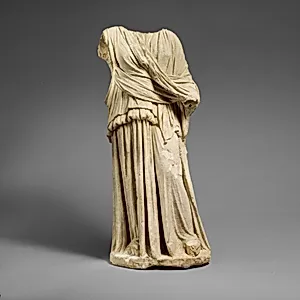
Limestone statue of Hera or Demeter (?)
Unknown Artist
ca. 330–200 BCE
Medium
Limestone
Dimensions
Overall: 26 3/4 x 11 3/4 x 9 1/2 in. (67.9 x 29.8 x 24.1 cm)
Classification
Stone Sculpture
Culture & Period
Cypriot · Early Hellenistic
Department
Greek and Roman Art
Museum
Metropolitan Museum of Art, New York, NY
Credit
The Cesnola Collection, Purchased by subscription, 1874–76
Accession Number
74.51.2729
Rights
Public Domain
Art Historical Context
This enigmatic limestone statue, possibly depicting the goddess Hera or Demeter, hails from ancient Cyprus during the Early Hellenistic period (ca. 330–200 BCE). Standing about 27 inches tall, it exemplifies Cypriot stone sculpture, a tradition blending Greek influences with local Eastern Mediterranean styles following Alexander the Great's conquests. The figure's draped form and poised stance reflect the era's shift toward more dynamic and expressive poses, characteristic of Hellenistic art's emotional depth and realism. Carved from local limestone—a durable medium prized in Cyprus for its fine grain and workability—the statue showcases skilled chisel work in rendering soft folds of clothing and subtle facial features. Its uncertain identification adds intrigue: Hera, queen of the gods, or Demeter, goddess of agriculture, both held vital roles in fertility cults prevalent on the island. Such votive or sanctuary figures were common in Cypriot temples, serving as offerings to divine protectors. Acquired through the Cesnola Collection in the 1870s, this piece entered the Metropolitan Museum of Art's Greek and Roman holdings, highlighting Cyprus's role as a cultural crossroads. Today, it invites visitors to ponder the divine feminine in antiquity, bridging myth and craftsmanship across millennia.