
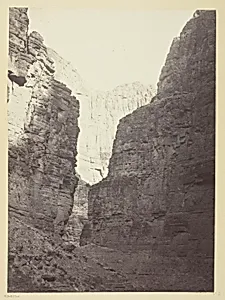
Limestone Walls Kanab Wash, Colorado River
1872
Medium
Albumen print
Dimensions
Image/paper: 27.6 × 20.1 cm (10 7/8 × 7 15/16 in.); Album page: 49.7 × 38.1 cm (19 5/8 × 15 in.)
Classification
albumen print from collodion negative
Department
Photography and Media
Museum
Art Institute of Chicago
Accession Number
181340
Rights
Public Domain
Art Historical Context
William H. Bell's *Limestone Walls, Kanab Wash, Colorado River* (1872) captures the raw majesty of the American Southwest during a pivotal era of exploration. As official photographer for John Wesley's second expedition down the Colorado River (187–72), Bell documented the uncharted canyons of the Grand Canyon region, including the dramatic limestone formations along Kanab, a tributary in what is now northern Arizona. This albumen print, measuring about 10 7/8 × 7 15/16 inches, offers visitors a window into the 19th-century push westward, when such images helped shape national perceptions of America's wild frontiers. Printed from a wet collodion negative—a technique requiring on-site development under primitive conditions—the albumen process yields the photograph's signature warm tones, fine detail, and luminosity. Coated with egg white (albumen) and sensitized with silver salts, these prints were the gold standard of mid-19th-century photography, prized for their clarity in portraying vast, rugged landscapes. Bell's composition emphasizes the towering, sheer walls against the river's flow, evoking both awe and the perils faced by explorers. Held in the Art Institute of Chicago's Photography and Media Department, this work underscores photography's role in scientific documentation and artistic expression, bridging exploration with emerging visual culture. It's a testament to how Bell's lens immortalized places few had seen, inspiring generations to appreciate the West's sublime geology.