
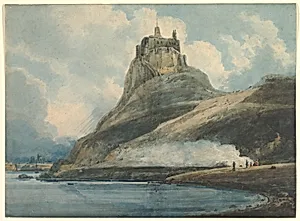
Lindisfarne Castle, Holy Island, Northumberland
1796–97
Medium
Watercolor
Dimensions
Sheet: 15 in. × 20 1/2 in. (38.1 × 52 cm)
Classification
Drawings
Department
Drawings and Prints
Museum
Metropolitan Museum of Art, New York, NY
Credit
Rogers Fund, 1906
Accession Number
06.1051.1
Rights
Public Domain
Tags
Art Historical Context
Thomas Girtin's *Lindisfarne Castle, Holy Island, Northumberland* (1796–97) captures the rugged beauty of England's northeastern coast in a masterful watercolor on a generous sheet measuring 15 × 20½ inches. As a young prodigy in the burgeoning British watercolor tradition, Girtin revolutionized the medium, transforming it from mere sketches into evocative, independent works of art. This piece, now in the Metropolitan Museum of Art's Drawings and Prints department (acquired via the Rogers Fund in 1906), showcases his talent for dramatic landscapes, highlighting the iconic silhouette of Lindisfarne Castle against rolling hills. Holy Island, accessible only by a tidal causeway, has long symbolized isolation and resilience—home to an ancient monastery raided by Vikings in 793 AD and later fortified with the castle. Girtin's view emphasizes the interplay of castle, cliffs, and terrain, rendered with fluid washes that convey atmospheric depth and the moody light of Northumberland's skies. His loose, bold technique influenced contemporaries like J.M.W. Turner, bridging 18th-century topography with Romantic sublime. This work invites visitors to ponder Britain's wild heritage, where human structures humbly nestle into nature's vastness—a testament to Girtin's enduring legacy in elevating watercolor to museum-worthy stature.
About the Artist
Thomas Girtin · 1775–1802
British painter. Comment on works: Landscapes