
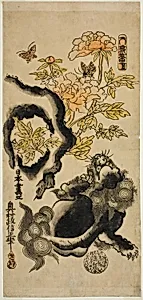
Lion and Peonies
c. 1720/25
Medium
Hand-colored woodblock print; hosoban, urushi-e
Dimensions
33.8 × 15.7 cm (13 5/16 × 6 3/16 in.)
Classification
woodblock print
Department
Arts of Asia
Museum
Art Institute of Chicago
Accession Number
88876
Rights
Public Domain
Art Historical Context
**Lion and Peonies** by Okumura Masobu, created around 1720–25, exemplifies the vibrant early ukiyo-e of Edo-period Japan. Masanobu, a pioneeringmaker active in Tokyo (then Edo), captured the "floating world" of fleeting pleasures through dynamic compositions. This hand-colored woodblock print in the narrow *hosoban* format (.8 × 15.7 cm) showcases a majestic lion amid lush peonies, blending ferocity with floral splendor—a classic motif symbolizing power and prosperity in Japanese culture. The *urushi-e* technique, meaning "lacquer print," is a highlight: Masanobu applied a glossy, lacquer-like substance to the paper before printing, lending the image a shimmering, jewel-like depth rarely seen in contemporaries. Hand-coloring added vivid hues, making these affordable prints luxurious collectibles for urban merchants and samurai. As one of the first to experiment with such effects, Masanobu influenced later masters like Suzuki Harunobu. Housed in the Art Institute of Chicago's Arts of Asia collection, this work reveals ukiyo-e's role in democratizing art during Japan's Genroku era, when woodblock printing exploded in popularity. Imagine the lion's fierce gaze leaping from the page, evoking both awe and the era's playful spirit!
About the Artist
Okumura Masanobu · 1686–1764
Japanese, 1686–1764