
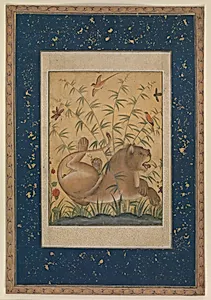
Lion at Rest
Unknown Artist
ca. 1585
Medium
Ink, opaque watercolor, silver, and gold on paper
Dimensions
Painting: H. 8 in. (20.3 cm) W. 6 in. (15.2 cm) Folio: H. 15 in. (38.1 cm) W. 10 1/4 in. (26 cm) Mat: H. 19 1/4 in. (48.9 cm) W. 14 1/4 in. (36.2 cm) Frame: H. 21 3/4 in. (54.6 cm) W. 16 3/4 in. (42.5 cm)
Classification
Codices
Department
Islamic Art
Museum
Metropolitan Museum of Art, New York, NY
Credit
The Alice and Nasli Heeramaneck Collection, Gift of Alice Heeramaneck, 1985
Accession Number
1985.221
Rights
Public Domain
Tags
Art Historical Context
Behold *Lion at Rest*, a captivating folio from a codex created around 1585, showcasing the exquisite artistry of the Islamic world. This small yet intricate painting (8 x 6 inches) depicts a majestic lion in repose amid birds and insects, rendered with remarkable naturalism on paper. Housed in the Metropolitan Museum of Art's Department of Islamic Art, it hails from The Alice and Nasli Heereck Collection, reflecting the refined aesthetic of Persianate manuscript traditions. Dating to circa 1585, the work likely emerged during the height of the Mughal Empire in India under Emperor Akbar, a period renowned for blending Persian, Indian, and European influences in miniature painting. As part of a codex—a bound manuscript—this piece exemplifies the era's fascination with the natural world, possibly from a bestiary or illustrated chronicle that celebrated wildlife's beauty and symbolism. Lions, symbols of power and nobility, were frequent motifs, evoking royal prowess. Artists employed ink for precise outlines, opaque watercolor for vibrant hues, and lavish silver and gold for shimmering highlights, techniques that brought the scene to life with luminous depth. These methods highlight the technical mastery of anonymous court ateliers, where patience and skill transformed paper into windows on nature's wonders, inviting viewers to ponder the harmony of the animal kingdom.