
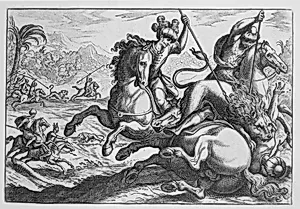
Lion Hunt, from 'Hunting Scenes IV'
late 16th century
Medium
Etching
Dimensions
Sheet: 7 9/16 × 10 7/8 in. (19.2 × 27.7 cm) Plate: 5 3/16 × 7 13/16 in. (13.2 × 19.8 cm)
Classification
Prints
Department
Drawings and Prints
Museum
Metropolitan Museum of Art, New York, NY
Credit
The Elisha Whittelsey Collection, The Elisha Whittelsey Fund, 1954
Accession Number
54.501.1(3)
Rights
Public Domain
Tags
Art Historical Context
Step into the thrilling world of late 16th-century Italian printmaking with Antonio Tempesta *Lion Hunt, from 'Hunting Scenes IV' an etching that captures the raw drama of the chase. Created during the vibrant transition from Renaissance to Baroque art, Tempesta, a master of dynamic animal scenes, produced this work as part of a series celebrating the hunt—a popular theme evoking classical antiquity and the aristocratic pursuits of the era. Housed in the Metropolitan Museum of Art's Drawings and Prints department, piece measures a compact 7 9/16 × 10 7/8 inches, making it an intimate yet powerful glimpse into historical spectacle. The scene bursts with action: fierce lions clash with spear-wielding men astride galloping horses, rendered in the fine, fluid lines characteristic of etching. This intaglio technique, where acid bites into a metal plate to create intricate details, allowed Tempesta to distribute his vivid compositions widely, influencing collectors and artists across Europe. The composition's energy—horses rearing, spears thrusting—highlights the medium's strength in conveying motion and tension on a small scale. As part of The Elisha Whittelsey Collection, this print not only showcases Tempesta's skill in blending realism with excitement but also reflects the cultural allure of exotic hunts, blending adventure with artistry for Renaissance audiences. A perfect gem for pondering humanity's timeless dance with nature's wild side!
About the Artist
Antonio Tempesta · 1555–1630
Antonio Tempesta (1555–1630), known as 'Il Tempestino,' was a Florentine painter and printmaker whose extraordinary output of approximately 1,700 etchings made him one of the most influential printmakers of the early Baroque period. Born in Florence and trained under Santi di Tito and the Flemish master Joannes Stradanus, he enrolled in the Accademia del Disegno in 1576 before relocating to Rome i...