
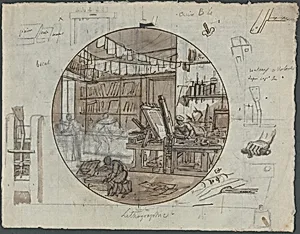
Lithographic Workshop
c. 1826
Medium
pen and brown ink and graphite with brown wash heightened with white goauche on laid paper
Dimensions
image (diameter): 13.7 cm (5 3/8 in.) sheet: 17.3 x 22.5 cm (6 13/16 x 8 7/8 in.)
Classification
Drawing
Department
CG-E
Museum
National Gallery of Art, Washington, D.C.
Credit
Rosenwald Collection
Accession Number
1980.45.54
Rights
Public Domain
Art Historical Context
Step into the bustling world of early 19th-century printmaking with *Lithographic Workshop* (c. 1826), a captivating drawing by French artist Jean-Charles Develly.ed in pen and brown ink with graphite, brown wash, and heightened white gouache on laid, this circular composition (13.7 cm diameter) a vivid snapshot of innovation. Housed in the National Gallery of Art'swald Collection, it exemplifies the meticulous mixed-media techniques artists used to capture light, texture, and depth on paper. Lithography, invented just decades earlier around 1798, exploded in popularity by the 1820s, revolutionizing art reproduction by allowing direct drawing on stone for high-quality prints. Develly, a skilled lithographer himself, likely created this scene as a tribute to the craft's workshop environment—imagine the hum of presses, the scent of stones, and artists at work transferring intricate designs. Its historical significance lies in documenting this pivotal moment when lithography democratized art, bridging fine drawing with mass production. The artwork's subtle washes and gouache highlights bring the scene to life, showcasing Develly's precision in evoking movement and machinery. A charming window into a transformative era, it reminds us how technical workshops fueled artistic progress. (198 words)