
Liverdun
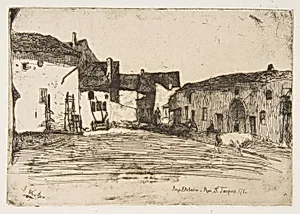
Medium
Etching, printed in black ink on gray chine on off-white wove paper (chine collé); third state of three (Glasgow)
Dimensions
Plate: 4 3/16 x 6 1/16 in. (10.6 x 15.4 cm) Sheet: 11 15/16 × 17 1/16 in. (30.3 × 43.4 cm)
Classification
Prints
Department
Drawings and Prints
Museum
Metropolitan Museum of Art, New York, NY
Credit
Harris Brisbane Dick Fund, 1917
Accession Number
17.3.9
Rights
Public Domain
Tags
Art Historical Context
James McNeill Whistler’s *Liverdun* (1858) captures a serene rural vignette from the French village of Liverdun in Lorraine, where the artist traveled that year. This etching depicts everyday life along a winding road lined with modest houses, grazing cows, and distant human figures, evoking the quiet charm of 19th-century provincial France. Created early in Whistler’s career, before his fame for atmospheric nocturnes and Aestheticism, it reflects his fascination with unpretentious landscapes and the working-class scenes that influenced his realist roots. Printed in black ink on gray chine collé—a delicate technique adhering thin Asian paper to off-white wove support for subtle tonal effects—this is the third (final) state from the Glasgow catalog. Etching allowed Whistler precise control over line and texture, rendering soft shadows and intricate details in the plate’s modest 4 3/16 x 6 1/16 inches. Part of his acclaimed “French Set,” it showcases his innovative printmaking, bridging traditional techniques with modern sensibility. Housed in the Metropolitan Museum of Art’s Drawings and Prints department (Harris Brisbane Dick Fund, 1917), *Liverdun* highlights Whistler’s pivotal shift toward subtle, evocative imagery, foreshadowing his later emphasis on “art for art’s sake.” A gem for print enthusiasts, it invites viewers to linger on its harmonious blend of human activity and pastoral calm.
About the Artist
James McNeill Whistler · 1834–1903
James Abbott McNeill Whistler (1834-1903) was an American-born painter and printmaker who became a leading figure in the Aesthetic Movement and pioneer of Tonalism and Japonisme. He revolutionized art by championing "art for art's sake" and treating paintings as visual equivalents of musical compositions, titling works as "arrangements," "harmonies," and "nocturnes" to emphasize formal qualities o...