
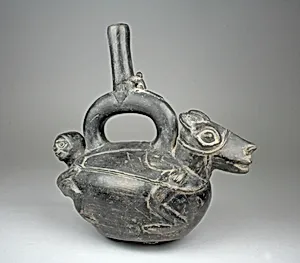
Llama Bottle
Unknown Artist
12th–15th century
Medium
Ceramic
Dimensions
H. 9 7/8 x W. 9 15/16 in. (25.1 x 25.3 cm)
Classification
Ceramics-Containers
Culture
Chimú
Department
Arts of Africa, Oceania, and the Americas
Museum
Metropolitan Museum of Art, New York, NY
Credit
Gift of Nathan Cummings, 1967
Accession Number
67.167.15
Rights
Public Domain
Tags
Art Historical Context
This charming *Llama Bottle*, crafted by an unknown Chimú artist between the 12th and 15th centuries, exemplifies the ceramics of Peru's north coast. The Chimú culture, which thrived in the region until their conquest by the Inca around 1470, was renowned for its sophisticated urban centers like Chan Chan and intricate artistry in clay. Standing at nearly 10 inches tall and wide (H. 9 7/8 x W. 9 15/16 in.), this vessel reflects the Chimú's skill in modeling naturalistic forms, with its llama shape capturing the animal's alert head and sturdy body—evident in the tags highlighting animal motifs. Fashioned from ceramic, the bottle likely served as a practical container for liquids, a common form in Chimú pottery known for its double-chamber designs and whistle-like spouts in some examples. The medium's earthy durability suited the arid coastal environment, while firing techniques produced the characteristic reddish-brown tones. Llamas, vital to Andean life for transport, wool, and sacrifice, symbolized strength and utility, making such zoomorphic vessels both functional and symbolic. Today, this piece graces the Metropolitan Museum of Art's Department of Arts of Africa, Oceania, and the Americas, a gift from Nathan Cummings in 1967. It invites visitors to ponder the Chimú's harmonious blend of daily life and artistry, bridging ancient Peru to our modern gaze.