
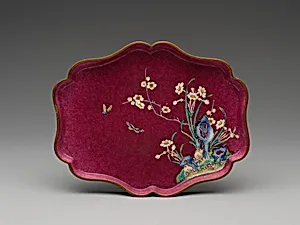
清中期 銅胎畫琺瑯花鳥圖盤|Lobed tray with rock, flowers, and butterflies
Unknown Artist
19th century
Medium
Painted enamel on copper alloy
Dimensions
L. 7 1/2 in. (19.1 cm); W. 5 3/4 in. (14.6 cm)
Classification
Enamels
Culture & Period
China · Qing dynasty (1644–1911)
Department
Asian Art
Museum
Metropolitan Museum of Art, New York, NY
Credit
Bequest of Mary Clark Thompson, 1923
Accession Number
24.80.341
Rights
Public Domain
Tags
Art Historical Context
This exquisite lobed tray, crafted in painted enamel on a copper alloy base during China's Qing dynasty (1644–1911) in the 19th century captures the refined artistry of mid-Qing decorative objects. Measuring just 7½ by 5¾ inches (19.1 by 14.6 cm), its delicate, scalloped form evokes the elegance of imperial workshops, where such trays served practical yet ornamental purposes—holding incense, sweets, or trinkets for scholarly or courtly pursuits. The vibrant scene of rocks, flowers, and butterflies exemplifies the painted enamel technique (known as *huayang cai* or painted enamels), where finely ground glass colors are applied directly to the metal surface and fired to create luminous, jewel-like effects. Popularized in the 18th century and flourishing into the 19th, this method allowed artists to achieve intricate, naturalistic details without the cloisonné wire outlines, blending European influences from Jesuit missionaries with traditional Chinese motifs. Flowers and butterflies, recurring symbols of beauty and seasonal renewal in Chinese art, infuse the tray with poetic harmony. Now housed in the Metropolitan Museum of Art's Asian Art Department through the 1923 bequest of Mary Clark Thompson, this anonymous masterpiece highlights the Qing era's mastery of enamelware, bridging utility and aesthetic splendor for everyday luxury.