
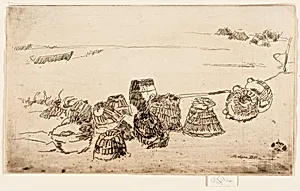
Lobster Pots - Selsea Bill
1880/81
Medium
Etching with foul biting in black ink on ivory laid paper
Dimensions
Plate: 11.8 × 20.1 cm (4 11/16 × 7 15/16 in.); Sheet: 12.7 × 20.1 cm (5 × 7 15/16 in.)
Classification
etching
Department
Prints and Drawings
Museum
Art Institute of Chicago
Accession Number
73478
Rights
Public Domain
Art Historical Context
James McNeill Whistler, renowned American-born artist celebrated for his "art for art sake" philosophy and subtle tonal harmonies, created *Lobster Pots - S Bill* around 1880–81. This intimate etching captures a quiet coastal scene at Selsey Bill, a rugged headland in West Sussex England, where lobster pots—traditional wicker traps used by fishermen—dot the shoreline. Whistler's work reflects his fascination with everyday subjects, transforming humble maritime elements into poetic compositions during a period when he was deeply engaged in printmaking, producing over 500 etchings in his career. The artwork's medium, etching with foul biting in black ink on ivory laid paper, showcases Whistler's masterful technique. Etching involves drawing through a wax ground on a metal plate, which is then submerged in acid to "bite" lines into the surface; foul biting occurs when acid unintentionally etches unprotected areas, creating a textured, atmospheric grain that adds depth and mood. Measuring just 11.8 × 20.1 cm on the plate, this print exemplifies Whistler's precision and his elevation of print as a fine art form, rivaling his famous oil paintings like the *Nocturnes*. Housed in the Art Institute of Chicago's Prints and Drawings collection, *Lobster Pots - Selsey Bill* highlights Whistler's influence on modern art, bridging Realism and Impressionism through evocative simplicity. Visitors can appreciate how these small-scale works invite close contemplation of light, texture, and the beauty in the ordinary.
About the Artist
James McNeill Whistler · 1834–1903
James Abbott McNeill Whistler (1834-1903) was an American-born painter and printmaker who became a leading figure in the Aesthetic Movement and pioneer of Tonalism and Japonisme. He revolutionized art by championing "art for art's sake" and treating paintings as visual equivalents of musical compositions, titling works as "arrangements," "harmonies," and "nocturnes" to emphasize formal qualities o...