
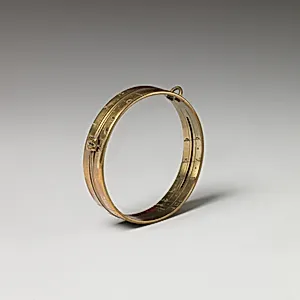
Local ring dial
17th century
Medium
Brass
Dimensions
Diameter: 2 1/8 in. (5.4 cm)
Classification
Horology
Culture
British
Department
European Sculpture and Decorative Arts
Museum
Metropolitan Museum of Art, New York, NY
Credit
Gift of Mrs. Stephen D. Tucker, 1903
Accession Number
03.21.23
Rights
Public Domain
Art Historical Context
Step into the ingenious world of 17th British horology with this delicate *Local ring dial* crafted by T. W. Measuring just 2 1/8 inches (5.4 cm) in, this brass instrument was designed to slip onto a finger like a ring, blending functionality with exquisite miniature craftsmanship. Housed in the Metropolitan Museum of Art's Department of European Sculpture and Decor Arts, it entered the collection as a gift from Mrs Stephen D. Tucker in1903. A "local ring dial" is a portable sundial, ingeniously engineered to determine local solar time by casting a shadow from a built-in gnomon (the projecting pin) onto a graduated brass dial. Users aligned it with the sun and adjusted for their latitude, making it a practical tool for travelers, astronomers, and scholars in an era before widespread pocket watches. Brass, prized for its durability and ability to hold fine engravings, allowed for precise calibrations essential to such devices. This artifact reflects Britain's burgeoning scientific curiosity during the 1600s, amid the Scientific Revolution, when horological innovations fueled navigation, exploration, and daily life. Its compact elegance showcases the era's mastery of metalworking, turning a utilitarian object into a decorative treasure that invites us to ponder how our ancestors measured fleeting time.