
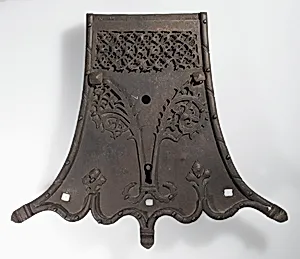
Lock
Unknown Artist
15th–16th century
Medium
Iron
Dimensions
Overall: 15 1/8 x 12 7/8 in. (38.4 x 32.7 cm)
Classification
Metalwork-Iron
Culture
European or German (?)
Department
The Cloisters
Museum
Metropolitan Museum of Art, New York, NY
Credit
The Cloisters Collection, 1955
Accession Number
55.61.11a–c
Rights
Public Domain
Art Historical Context
Nestled in The Cloisters collection at the Metropolitan Museum of Art this imposing iron lock from the th–16th century the robust metalwork of late medieval Europe, possibly German in origin. Measuring a substantial 15 1/8 x 12 7/8 inches, it was likely designed for securing doors, gates, or chests in homes castles, or ecclesiastical settings, where protection against theft was paramount amid turbulent times of feudal conflicts and trade expansion. Crafted from forged iron—a durable medium that allowed blacksmiths to create intricate mechanisms—this artifact highlights the era's advancing locksmithing techniques. Artisans combined strength with precision, developing tumbler systems that represented a leap in mechanical ingenuity, safeguarding valuables as Renaissance commerce boomed. Though the artist remains unknown, the lock's survival speaks to the high value placed on such functional art, blending utility with masterful metallurgy. Today, it invites us to ponder everyday innovations of the past, revealing how ordinary objects embodied cultural priorities of security and craftsmanship in pre-industrial Europe. A testament to anonymous skilled hands, it bridges history and human ingenuity.