
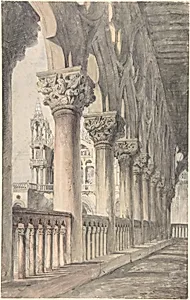
Loggia of the Ducal Palace, Venice
1849–50
Medium
Watercolor over graphite
Dimensions
Sheet: 18 1/8 × 11 7/16 in. (46 × 29 cm)
Classification
Drawings
Department
Drawings and Prints
Museum
Metropolitan Museum of Art, New York, NY
Credit
Rogers Fund, 1908
Accession Number
08.227.39
Rights
Public Domain
Tags
Art Historical Context
Welcome to the Metropolitan Museum of Art's Drawings and Prints department, where John Ruskin's *Loggia of the Duc Palace, Venice* (9–50) captivates with its precise watercolor over graphite. This 18 1/8 × 11 7/16 in. sheet captures the intricate arcade of Venice's iconic Doge's Palace, a masterpiece of Venetian Gothic architecture with slender columns that blend Byzantine and Islamic influences. Ruskin, leading 19th-century critic and artist, rendered these details with topographic accuracy, highlighting the palace's ornate tracery and sculptural elegance. Created during Ruskin's fervent campaigns to document Venice's decaying Gothic treasures—later immortalized in his seminal *The Stones of Venice* (1851–53)—this work reflects his passion for architecture as moral and aesthetic instruction. He sketched tirelessly on-site, using graphite underdrawings for meticulous outlines before layering translucent watercolors to evoke stone's luminosity and texture. The medium's delicacy suits his topographic style, emphasizing structure over embellishment. Acquired via the Rogers Fund in 1908, this drawing invites us to appreciate Venice's layered history through Ruskin's reverent eye, reminding visitors of architecture's power to inspire ethical reflection and artistic revival.
About the Artist
John Ruskin · 1819–1900
Ruskin was the most important British architectural critic of the nineteenth century. While still an undergraduate, Ruskin contributed a number of articles on "The Poetry of Architecture" under the nom de plume of Kata Phusin to J. C. Loudon's "Architectural Magazine." He was appointed first Slade Professor at Oxford University in 1868. He is the author of "The Stones of Venice."