
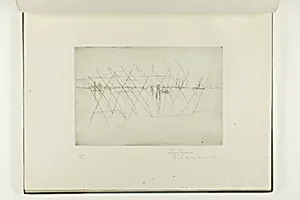
Long Lagoon
1879/80
Medium
Etching and drypoint, with drypoint cancellation, in black ink on ivory laid paper
Dimensions
Plate: 15.2 × 22.7 cm (6 × 8 15/16 in.); Sheet, sight, bound: 27.5 × 37.8 cm (10 7/8 × 14 15/16 in.)
Classification
etching
Department
Prints and Drawings
Museum
Art Institute of Chicago
Accession Number
180992
Rights
Public Domain
Art Historical Context
James McNeill Whistler’s *Long Lagoon* (1879/80) captures the serene beauty of Venice during the artist’s immersive stay in the city. A master of the Aesthetic movement, Whistler prioritized mood and harmony over narrative, creating this intimate etching as part of his acclaimed “Second Venice Set.” Printed in black ink on ivory laid paper, the measures a modest plate size of 15.2 × 22.7 cm, inviting viewers into the lagoon’s misty expanse with subtle tonal gradations. Whistler’s etching and drypoint techniques shine here, blending precise linework with the soft, velvety burr of drypoint for atmospheric depth. The innovative “drypoint cancellation”—where he scratched the plate to refine or halt editions—ensures each impression is uniquely textured, a hallmark of his experimental printmaking. Produced amid Whistler’s financial struggles and artistic evolution post his famous “Whistler’s Mother” portrait, these Venice prints revitalized etching as fine art, influencing modernists like Picasso. Housed in the Art Institute of Chicago’s Prints and Drawings department, *Long Lagoon* exemplifies Whistler’s philosophy of “art for art’s sake,” evoking the lagoon’s quiet poetry and the fleeting light of twilight. A gem for print enthusiasts, it reminds us how a small sheet can transport us across centuries.
About the Artist
James McNeill Whistler · 1834–1903
James Abbott McNeill Whistler (1834-1903) was an American-born painter and printmaker who became a leading figure in the Aesthetic Movement and pioneer of Tonalism and Japonisme. He revolutionized art by championing "art for art's sake" and treating paintings as visual equivalents of musical compositions, titling works as "arrangements," "harmonies," and "nocturnes" to emphasize formal qualities o...