
Longshoremen
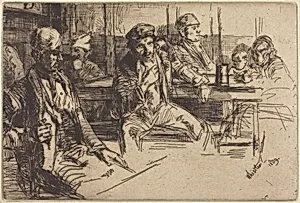
Medium
etching and drypoint on green laid paper
Dimensions
plate: 15.24 x 22.86 cm (6 x 9 in.) sheet: 22.86 x 30.48 cm (9 x 12 in.)
Classification
Department
CG-W
Museum
National Gallery of Art, Washington, D.C.
Credit
Rosenwald Collection
Accession Number
1943.3.8429
Rights
Public Domain
Art Historical Context
James McNeill Whistler’s *Longshoremen* (1859) captures the gritty vitality of London’s Thames docks, where burly workers unload cargo in a scene brimming with everyday realism. Created during Whistler’s early career, after his time in Paris absorbing influences from Realist masters like Courbet, this print reflects his fascination with urban labor and atmospheric effects. As a pioneering figure in Aestheticism, Whistler here prioritizes mood and form over narrative, foreshadowing his later celebrated nocturnes and tonal harmonies. The work is an etching and drypoint on rare green laid paper, a technique that showcases Whistler’s masterful printmaking. Etching involves acid-etched lines on a metal plate for precision, while drypoint’s direct needle scratches create velvety burrs for rich, textured depth. The unconventional green paper infuses the scene with an evocative, almost moody tonality, enhancing the hazy industrial atmosphere. Measuring just 6 x 9 inches on the plate, its intimate scale invites close viewing. Housed in the National Gallery of Art’s Rosenwald Collection, *Longshoremen* exemplifies Whistler’s innovative etchings from the Thames Set, bridging 19th-century Realism and modern art. It offers a window into Victorian working-class life, reminding us how Whistler elevated the ordinary into poetry. (198 words)
About the Artist
James McNeill Whistler · 1834–1903
James Abbott McNeill Whistler (1834-1903) was an American-born painter and printmaker who became a leading figure in the Aesthetic Movement and pioneer of Tonalism and Japonisme. He revolutionized art by championing "art for art's sake" and treating paintings as visual equivalents of musical compositions, titling works as "arrangements," "harmonies," and "nocturnes" to emphasize formal qualities o...