
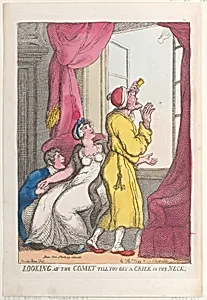
Looking at the Comet till You Get a Crick in the Neck
September 20, 1811
Medium
Hand-colored etching
Dimensions
Plate: 13 11/16 × 9 5/8 in. (34.8 × 24.5 cm) Sheet: 15 5/16 × 10 5/16 in. (38.9 × 26.2 cm)
Classification
Prints
Department
Drawings and Prints
Museum
Metropolitan Museum of Art, New York, NY
Credit
The Elisha Whittelsey Collection, The Elisha Whittelsey Fund, 1959
Accession Number
59.533.1437
Rights
Public Domain
Tags
Art Historical Context
Step into the whimsical world of Regency-era satire with *Looking at the Comet till You Get a Crick in the Neck*, a hand-colored etching by Thomas Rowlandson, by Thomas Tegg on September 20, 1811. Rowlandson, a prolific British caricaturist, captures a crowd of men and women craning their necks skyward in exaggerated awe, poking fun at the public's obsession with a spectacular celestial event. This lively print, measuring about 13¾ by 9⅝ inches on the plate, exemplifies the vibrant hand-coloring technique that brought Rowlandson's humorous scenes to life, making them instant hits among collectors and the chattering classes. Created amid the excitement of the Great Comet of 1811—one of the brightest in recorded history, visible for 17 months—this artwork satirizes the era's blend of scientific wonder and superstitious frenzy. Comets were often seen as omens, fueling gossip about wars, plagues, or royal scandals during the Regency period under George III's regency. Rowlandson's etching, with its bold lines and cheeky details, reflects the booming market for affordable satirical prints, which Tegg popularized through his London shop. Housed in the Metropolitan Museum of Art's Drawings and Prints department, this piece highlights Rowlandson's mastery of caricature, blending sharp social observation with infectious humor. It's a delightful reminder of how art captured fleeting moments of collective fascination, inviting us to chuckle at our ancestors' starry-eyed enthusiasm.
About the Artist
Thomas Rowlandson|Thomas Tegg · 1756–1827
Thomas Rowlandson (1757–1827) was an English artist and caricaturist whose satirical watercolors and prints captured the social life of Georgian Britain with unparalleled wit and technical mastery. Alongside James Gillray, he is recognized as one of the greatest British graphic artists, and his distinctive flowing line and keen observations have made his work integral to understanding late 18th an...