
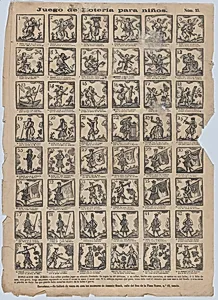
Lottery game for children
ca. 1860–1870
Medium
Wood engraving
Dimensions
Sheet: 17 5/16 × 12 3/16 in. (44 × 31 cm)
Classification
Prints
Department
Drawings and Prints
Museum
Metropolitan Museum of Art, New York, NY
Credit
Max G. Wildnauer Fund, 1978
Accession Number
1978.643.32
Rights
Public Domain
Tags
Art Historical Context
Created around 1860–1870, *Lottery game for children is a wood engraving by Antonio Bosch that captures the growing popularity of printed games during the Victorian era. As mass production made affordable entertainment widely available, such sheets offered families engaging pastimes that combined play with gentle instruction. The work’s classification as a reflects the period’s enthusiasm for accessible visual culture designed for home use. Bosch employed wood engraving, a technique prized for its ability to render fine lines and intricate details on durable blocks. This medium allowed artists to produce crisp, reproducible images suitable for games, illustrations, and educational materials. Measuring roughly 17 by 12 inches, the sheet would have been easy to display or handle, inviting children to participate in the lottery format while enjoying the lively imagery. Housed in the Metropolitan Museum’s Department of Drawings and Prints, this example highlights how 19th-century printmakers blended artistry with everyday amusement. The work’s focus on games underscores the era’s belief that recreation could foster learning and social interaction within the family circle.