
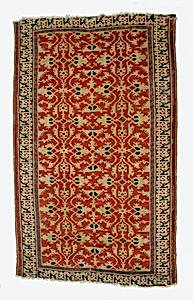
'Lotto' Carpet
Unknown Artist
16th century
Medium
Wool (warp, weft and pile); symmetrically knotted pile
Dimensions
Rug: L. 85 1/2 in. (217.2 cm) W. 51 1/4 in. (130.2 cm) Wt. 19 lbs. (8.6 kg) with cradle
Classification
Textiles-Rugs
Department
Islamic Art
Museum
Metropolitan Museum of Art, New York, NY
Credit
Rogers Fund, 1908
Accession Number
08.167.1
Rights
Public Domain
Art Historical Context
Step into the opulent world of 16th-century Islamic art with the *Lotto* Carpet, a stunning wool rug from the Ottoman Empire, likely woven in Anatolia (modern-day Turkey). Measuring an impressive 85½ by 51¼ inches and weighing nearly 19 pounds, this sized piece was crafted for both practical use and aesthetic grandeur, reflecting the era's mastery of textile traditions. Acquired through the Rogers Fund in 1908, it now graces the Metropolitan Museum of Art Islamic Art collection. The carpet's name derives from Italian Renaissance painter Lorenzo Lotto, who famously depicted similar designs in his portraits, introducing these intricate patterns to European audiences. Its symmetrically knotted pile—a hallmark of Turkish knotting—ensures exceptional durability and fine detail, with wool used for warp, weft, and pile. This technique allowed weavers to create vibrant, densely textured surfaces that captured floral motifs and geometric medallions, blending functionality with artistry. As a prime example of Ottoman rug-making, *Lotto* Carpet highlights the cultural crossroads of the Silk Road, where Islamic craftsmanship influenced global design. Visitors often marvel at its preserved richness, a testament to enduring weaving skill.