
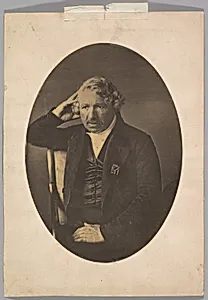
Louis-Jacques-Mandé Daguerre
Medium
Albumen silver print from glass negative
Dimensions
Image: 7 7/16 × 5 5/16 in. (18.9 × 13.5 cm) Mount: 9 5/8 in. × 6 13/16 in. (24.5 × 17.3 cm)
Classification
Photographs
Department
Photographs
Museum
Metropolitan Museum of Art, New York, NY
Credit
Gilman Collection, Purchase, Warner Communications Inc. Purchase Fund, by exchange, 2005
Accession Number
2005.100.772
Rights
Public Domain
Tags
Art Historical Context
This striking portrait captures Louis-Jacques-Mandéuerre, the pioneering French artist and chemist hailed as the "father of photography" for the daguerreotype process 1839. Photographed by the acclaimed British portraitist John Jz Edwin Mayall around1860, the image honors Daguerre two decades after his groundbreaking contribution revolutionized image-making, shifting from painting to precise, light-captured realism. Rendered as an albumen silver from a glass negative—a mid-19th-century technique—the photograph uses egg-white emulsion to create rich tonal depth and sharp detail on paper. This method, introduced in the 1850s, allowed for multiple prints from a single negative, making photography more accessible than the one-of-a-kind daguerreotype. Mayall's composition highlights Daguerre's dignified gaze and period attire, embodying the era's fascination with photography's inventors. Housed in The Metropolitan Museum of Art's Gilman Collection, this 7 7/16 × 5 5/16-inch image exemplifies how 19th-century portraits immortalized cultural icons, bridging art and science in a transformative medium.