
Louisa DuPonceau
1798-1803
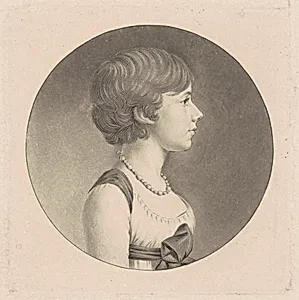
Medium
engraving in black on wove paper
Dimensions
image (irregular): 5.56 × 5.56 cm (2 3/16 × 2 3/16 in.) plate: 6.51 × 6.35 cm (2 9/16 × 2 1/2 in.) sheet: 17.46 × 13.18 cm (6 7/8 × 5 3/16 in.)
Classification
Department
CG-W
Museum
National Gallery of Art, Washington, D.C.
Credit
Corcoran Collection
Accession Number
2015.19.2474
Rights
Public Domain
Art Historical Context
Step into the early American republic with *Louisa DuPonceau*, a delicate 1798–1803 engraving by Charles B. J. Févret de Saint-Mémin. intimate profile portrait, measuring just over 2 inches square, captures the young subject's refined features in precise black lines on smooth wove paper. Saint-Mémin, a émigré who arrived in Philadelphia amid the Revolution's aftermath, specialized in such miniature likenesses, blending European engraving finesse with New World portraiture. His innovative technique began with a physiognotrace—a mechanical device that traced sitters' profiles onto paper—followed by meticulous hand-engraving for distribution as collectible prints. These small-scale works were revolutionary for their affordability and detail, allowing middle- and upper-class Americans to own sophisticated portraits without commissioning costly oils. Produced during a time of national identity-building, they document the era's elite, including figures like Louisa, possibly kin to the prominent scholar Pierre Du Ponceau. Housed in the National Gallery of Art's Corcoran Collection, this print exemplifies Saint-Mémin's legacy: over 800 profiles that offer a vivid social snapshot of post-Revolutionary society. Its compact elegance invites close viewing, revealing the artistry in every etched curl and contour—a window to 19th-century America's poised beginnings.
About the Artist
Charles B. J. Févret de Saint-Mémin · 1770–1852
**Charles Balthazar Julien Févret de Saint-Mémin** Born on March 12, 1770, in Dijon, France, to marquis Bénigne-Charles Févret de Saint-Mémin, a former conseiller au Parlement de Bourgogne, and Victoire-Marie de Motmans, a creole from Port-au-Prince, Charles Balthazar Julien Févret de Saint-Mémin received a military education at the École Militaire in Paris, graduating in 1785. He served as a cad...