
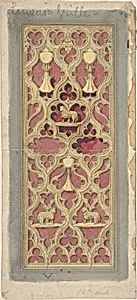
Louvain Church Grille
second half 19th century
Medium
Pen and ink and watercolor
Dimensions
sheet: 9 3/4 x 4 7/16 in. (24.7 x 11.2 cm)
Classification
Drawings|Ornament & Architecture
Department
Drawings and Prints
Museum
Metropolitan Museum of Art, New York, NY
Credit
The Elisha Whittelsey Collection, The Elisha Whittelsey Fund, 1960
Accession Number
60.632.145
Rights
Public Domain
Tags
Art Historical Context
Nestled in the Metropolitan Museum of Art's Drawings and Prints department, *Louvain Church Gr* is a exquisite pen and ink with watercolor drawing by an anonymous artist from the second half of the19th century. Measuring just 9 3/4 x 4 7/16 inches, this intimate sheet meticulously renders the ornate grille—likely a decorative screen or gate—from a church in Louvain (modern-day Leuven, Belgium). Acquired through The Elisha Whittelsey Collection in 1960 it exemplifies the precision of Victorian-era topographical studies. Created amid Britain's Gothic Revival fervor, the work reflects a broader 19th-century fascination with medieval European architecture. British travelers and architects often sketched continental treasures like this to inspire designs back home, preserving intricate details of stone or metalwork that might otherwise fade. The classification as Ornament & Architecture underscores its focus on decorative elements, with animal motifs adding a lively, symbolic touch—evoking the zoomorphic carvings common in Gothic churches, where creatures like lions or birds symbolized spiritual virtues. The artist's technique shines in the fine pen lines delineating filigree patterns, enhanced by subtle watercolor washes for depth and texture. This small gem invites visitors to appreciate how such drawings bridged art and scholarship, capturing cultural heritage in a portable, personal format.
About the Artist
Anonymous, British, 19th century · 1800–1900
**Anonymous, British, 19th century** is not the name of a single individual but a standard museum attribution used for works whose creators remain unidentified yet are clearly British and date to the 1800s. Major institutions, including the Metropolitan Museum of Art, employ this designation for hundreds of drawings, prints, designs, and decorative studies that lack signatures or firm documentary ...