
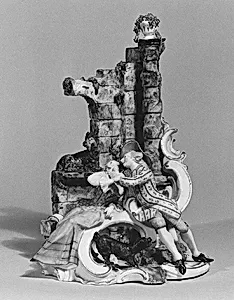
Love amid ruin
Medium
Hard-paste porcelain
Dimensions
11 1/4 × 7 3/4 in. (28.6 × 19.7 cm)
Classification
Ceramics-Porcelain
Culture
German, Nymphenburg
Department
European Sculpture and Decorative Arts
Museum
Metropolitan Museum of Art, New York, NY
Credit
The Lesley and Emma Sheafer Collection, Bequest of Emma A. Sheafer, 1973
Accession Number
1974.356.522
Rights
Public Domain
Tags
Art Historical Context
**Love amid Ruin** (ca. 1756), crafted by the renowned Nymphenburg Porcelainufactory under the masterful hand of modeler Franz Anton Bustelli exemplifies the pinnacle of 18th-century German Rococo porcelain artistry. This hard-paste porcelain figurine group, measuring 11¼ × 7¾ inches, captures a tender romantic moment between a man and woman set against crumbling ruins, with animals adding a touch of whimsy. Bust, active at Nymphenburg from 1754 until his early death in 1763, was celebrated for his ability to infuse porcelain with lifelike grace and intricate detail, rivaling the finest Meissen works. Hard-paste porcelain, prized for its durability and translucency, allowed Bustelli to sculpt delicate fabrics, expressive faces, and textured ruins with astonishing realism. Produced during the opulent Rococo era under Bavarian electoral patronage, such pieces adorned aristocratic tables and cabinets, blending themes of love's endurance amid decay—a poetic nod to fleeting beauty and human passion. Today, housed in The Metropolitan Museum of Art as part of The Lesley and Emma Sheafer Collection, this work highlights Nymphenburg's cultural legacy as a hub of European decorative arts, inviting visitors to marvel at porcelain's transformative power from humble clay to elegant storytelling.