
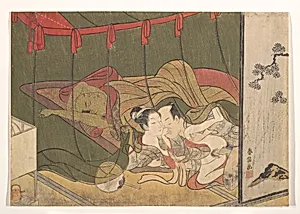
Lovers Beneath a Mosquito Net
18th century
Medium
Woodblock print; ink and color on paper
Dimensions
Image: 7 5/8 x 11 in. (19.4 x 27.9 cm)
Classification
Prints
Culture & Period
Japan · Edo period (1615–1868)
Department
Asian Art
Museum
Metropolitan Museum of Art, New York, NY
Credit
Bequest of William S. Lieberman, 2005
Accession Number
2007.49.265
Rights
Public Domain
Tags
Art Historical Context
Suzuki Harunobu’s *Lovers Beneath a Mosquito Net* captures a tender, private moment between a man and woman sheltered beneath translucent netting, a common motif in eighteenth-century Japanese prints. Created during the Edo period, the work belongs to the ukiyo-e tradition that celebrated the fleeting pleasures of urban life. Harunobu, active in the 1760s and 1770s, helped pioneer full-color woodblock printing, transforming earlier limited palettes into the vibrant nishiki-e (“brocade pictures”) that made such intimate scenes widely accessible. The medium itself—ink and color printed from multiple carved blocks onto fine paper—allowed artists to suggest delicate textures like the gauzy mosquito net and soft bedding with remarkable economy. Measuring just under eight by eleven inches, the print was likely designed for personal albums or private viewing rather than public display, reflecting the Edo fascination with both refined beauty and everyday sensuality. Today the work offers visitors a glimpse into the refined yet playful visual culture of Edo Japan, where even the simplest domestic detail could convey warmth, intimacy, and the quiet poetry of human connection.
About the Artist
Suzuki Harunobu · 1725–1770
Suzuki Harunobu (c. 1725-1770) was a Japanese ukiyo-e artist who revolutionized woodblock printing by developing nishiki-e—full-color prints using multiple woodblocks—in 1765. Before Harunobu, Japanese prints were limited to two or three colors; his innovation unleashed the entire artist's palette, transforming ukiyo-e into the vibrant art form that would later captivate Western artists from Manet...