
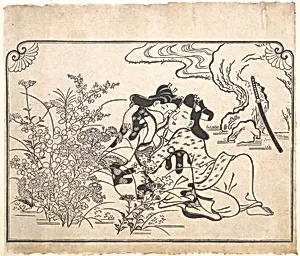
Lovers Beside Flowering Autumn Grasses
Medium
Woodblock print; ink on paper
Dimensions
9 1/4 × 13 1/4 in. (23.5 × 33.7 cm)
Classification
Prints
Culture & Period
Japan · Edo period (1615–1868)
Department
Asian Art
Museum
Metropolitan Museum of Art, New York, NY
Credit
Harris Brisbane Dick Fund and Rogers Fund, 1949
Accession Number
JP3069
Rights
Public Domain
Tags
Art Historical Context
In the lush tradition of ukiyo-e, or "pictures of the floating world," Hishikawa Morobu's *Lovers Beside Flowering Grasses* (1680s) captures a tender moment of romance amid nature's fleeting beauty. This woodblock, rendered in ink on paper, measures a modest 9¼ × 13¼ inches, its intimate scale draws viewers into the lovers' secluded world. Moronobu, a pioneering Edo-period artist (1615–1868), helped popularize single-sheet prints that celebrated everyday pleasures like love and seasonal landscapes, making art accessible beyond elite circles. The scene evokes autumn's pampas grasses in bloom—symbols of transience in Japanese culture—framing a couple in harmonious embrace. Moronobu's masterful use of bold lines, subtle shading through ink dilution (known as *sukashi*), and vibrant composition reflects early ukiyo-e techniques, bridging hand-drawn illustrations with the mass-produced woodblock process. Printed during Japan's vibrant Genroku era, when urban culture flourished in Edo (modern Tokyo), it highlights themes of *irozato* (erotic encounters), blending sensuality with poetic restraint. Housed in the Metropolitan Museum of Art's Asian Art Department, this print exemplifies Moronobu's enduring legacy as the first true ukiyo-e master, influencing giants like Hiroshige and Hokusai. A window into 17th-century Japan's joie de vivre, it reminds us that beauty, like autumn grasses, blooms briefly but memorably.
About the Artist
Hishikawa Moronobu 菱川師宣 (Japanese) · 1618 –1694
Japanese, 1618–1694