
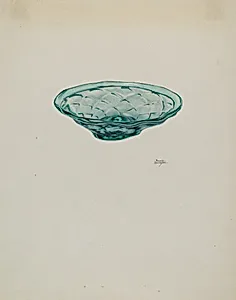
Low Glass Dish
c. 1940
Medium
watercolor, graphite, and colored pencil on paper
Dimensions
overall: 31.9 x 24.5 cm (12 9/16 x 9 5/8 in.)
Classification
Index of American Design
Department
CG-W
Museum
National Gallery of Art, Washington, D.C.
Credit
Index of American Design
Accession Number
1943.8.11013
Rights
Public Domain
Art Historical Context
Behold the delicate *Low Glass Dish*, a captivating rendering by artist Beverly Chichester, created around 1940. Measuring 31.9 x 24.5 cm, this work on paper masterfully combines watercolor, graphite, and colored pencil to capture the subtle elegance of an everyday American glass object. Chichester's precise technique highlights the dish's graceful curves and translucent qualities, transforming a humble utilitarian item into a study of form and light. This artwork is a gem from the Index of American Design, a monumental WPA Federal Art Project (1935–1942) that employed artists to document America's rich heritage of folk art, crafts, and design. By meticulously rendering objects like this low glass dish—likely an example of early 20th-century American glassmaking—Chichester helped preserve cultural artifacts amid the Great Depression. The Index's 15,000+ watercolors now form a vital archive at the National Gallery of Art, celebrating the ingenuity of anonymous makers. Chichester's mixed-media approach exemplifies the project's emphasis on accuracy and artistry: graphite for sharp outlines, watercolor for luminous depth, and colored pencil for fine textures. It's a window into America's design legacy, reminding us how ordinary objects embody national creativity and resilience.
About the Artist
Beverly Chichester · 1904–1967
Beverly Chichester was an American artist active in the mid-1930s and early 1940s, whose contributions to the Index of American Design reveal an eye particularly drawn to the world of American toys, dolls, and childhood objects. Working in watercolor, gouache, colored pencil, and graphite on paperboard, Chichester produced a body of work distinguished by its delicacy of observation and its sympath...