
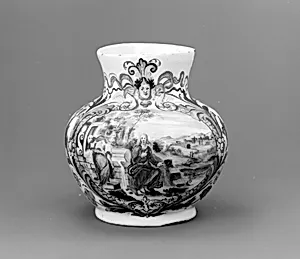
Low jug
17th century
Medium
Faience (tin-glazed earthenware)
Dimensions
H. 5-1/2 in. (14.0 cm)
Classification
Ceramics-Pottery
Culture
German, Frankfurt
Department
European Sculpture and Decorative Arts
Museum
Metropolitan Museum of Art, New York, NY
Credit
Gift of the family of Siegfried and Lola Kramarsky, in their memory, 1991
Accession Number
1991.207.4
Rights
Public Domain
Tags
Art Historical Context
This charming low jug, crafted in 17th-century Frankfurt by Abraham Helmhack (also associated with Feulner), exemplifies the vibrant faience tradition of German pottery. Standing just 5-1/2 inches tall, this tin-glazed earthenware piece was produced in a city renowned for its ceramics workshops, which rivaled Dutch and Italian centers by imitating luxurious Chinese porcelain. The tin glaze created a smooth, white canvas ideal for vibrant painted decorations, fired at lower temperatures than true porcelain, making it an accessible yet elegant household item. Likely adorned with scenes of Christ and women—common biblical motifs in Frankfurt faience—the jug reflects the era's deep religious devotion amid the Protestant Reformation's influence in the region. These narrative designs, often in blue monochrome or polychrome, blended artistic storytelling with everyday utility, showcasing the potters' skill in delicate modeling and glaze application. Such wares highlight Frankfurt's role as a hub for innovative European decorative arts. Today, this intimate vessel graces The Metropolitan Museum of Art's European Sculpture and Decorative Arts collection, a 1991 gift from the Kramarsky family. It invites visitors to appreciate how humble ceramics carried profound cultural and spiritual weight in 17th-century homes.
About the Artist
Feulner|Abraham Helmhack (German| ) · 1650 |1654 –1750 |1724
German|1654–1724