
Medium
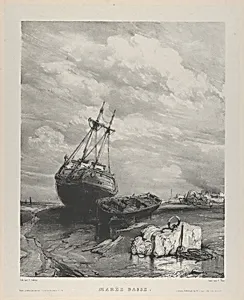
Lithograph on chine collé; first state of two, without griffonage on upper right
Dimensions
Sheet: 18 1/2 × 13 3/16 in. (47 × 33.5 cm) Image: 14 in. × 11 5/16 in. (35.5 × 28.7 cm)
Classification
Prints
Department
Drawings and Prints
Museum
Metropolitan Museum of Art, New York, NY
Credit
Rogers Fund, 1922
Accession Number
22.57.2
Rights
Public Domain
Tags
Art Historical Context
"Low Tide," a captivating 1833 lithograph on chine collé, the serene yet evocative beauty of a receding sea. Created by French Romantic artist Eugène Isab in collaboration with printers Charles Motte, McLean & Co., and Victor Mor, this first-state impression (sans griffonage in the upper right) measures 18½ × 13 inches overall. Housed in the Metropolitan Museum Art's Drawings and Prints since 1922 via the Rogers Fund, exemplifies early 19th-century print innovation. Lithography, perfected around 1800, allowed artists like Isabey—renowned for his dramatic marine scenes—to translate painterly effects onto paper with remarkable fluidity. The chine collé technique, bonding delicate Chinese rice paper to a sturdy support, enhanced color richness and detail retention, making complex compositions like this tidal seascape accessible through affordable prints. Isabey's Romantic sensibility shines in the stranded boats and ships, evoking nature's quiet power and humanity's humble place amid it. This work reflects the era's fascination with maritime life, bridging fine art and popular reproduction. Spot the subtle textures of wet sand and becalmed vessels—hallmarks of Isabey's seafaring expertise—inviting visitors to ponder the rhythm of tides in an age of exploration.
About the Artist
Charles Motte|McLean & Co.|Victor Morlot|Eugène Isabey (French|French|French) · 1803 |1785 |1785 –1860 |1836 |1836
French, Paris 1803–1860 Fontainebleau|French, 1785–1836|French, 1785–1836